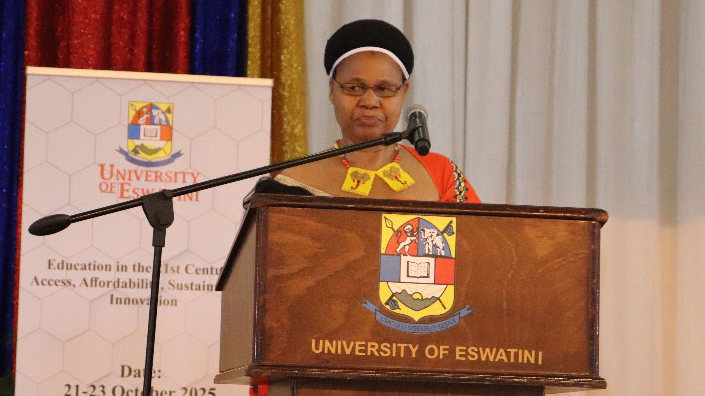
KWALUSENI – Inkhosikati LaMatsebula has officially opened the 2025 ESWERA–DEASA–KEAS–RSTP International Conference at the University of Eswatini (UNESWA), Kwaluseni Campus, calling for stronger collaboration, innovation, and research-driven transformation in education across the region.
The three-day conference, which runs until Thursday, October 23, is held under the theme “Education in the 21st Century: Access, Affordability, Sustainability, Innovation and Relevance.” It has drawn participants from across Southern Africa, including educators, researchers, policymakers, and technology experts, to discuss solutions to modern education challenges.
In her keynote address, Inkhosikati LaMatsebula described the event as “an honour and a privilege,” commending the collaboration between the Eswatini Educational Research Association (ESWERA), Distance Education Association of Southern Africa (DEASA), Knowledge, Education and Advisory Services (KEAS), and the Royal Science and Technology Park (RSTP).
“This conference is a significant occasion that celebrates the heritage of educational research while looking toward the future of innovation in Eswatini and across Southern Africa,” she said.
She reflected on ESWERA’s journey, noting that the association—formerly known as SERA—was founded in the early 1980s under the BOLESWA vision, and has since strengthened the link between research, teaching, and policymaking.
“Despite financial challenges, ESWERA has amplified local scholars’ voices, shaped educational dialogues, and connected Eswatini to regional research networks,” she noted.
Driving innovation and inclusivity
Inkhosikati LaMatsebula reaffirmed government’s commitment to advancing education through research and digital transformation, applauding the Ministry of ICT for its leadership in driving innovation through the Royal Science and Technology Park (RSTP), established by an Act of Parliament in 2012.
“The RSTP stands as a testament to our dedication to science and technology,” she said, highlighting innovative start-ups such as Shunifu, Edusphere, and Groening Associates, which are developing digital learning and research solutions.
She also praised national initiatives like the National Research Council (NRC), the Women in Science, Engineering and Technology (WISET) programme, and the Young Academy of Sciences, all designed to build a knowledge-driven, inclusive society.
“These initiatives demonstrate Eswatini’s commitment to fostering innovation and empowering future generations,” she said.
Promoting open and distance learning
The patron further commended DEASA for promoting open and distance learning across the SADC Region, noting its strong partnership with UNESWA’s Institute of Distance Education (IDE).
“This partnership stands as a model for inclusive learning, proving that accessibility and affordability can go hand in hand,” she said.
Inkhosikati LaMatsebula emphasised that access, affordability, sustainability, innovation, and relevance must form the cornerstone of educational reform.
“Every child, youth, and adult deserves a place at the table of learning,” she said. “Education must not only be inclusive and affordable, but also sustainable and relevant to the needs of our economy and communities.”
She concluded her address by urging stronger collaboration among government, academia, and the private sector to accelerate educational transformation through research and digital innovation.
Inkhosikati LaMatsebula then officially declared the conference open, quoting Nelson Mandela’s timeless words:
“Education is the most powerful weapon which you can use to change the world.”