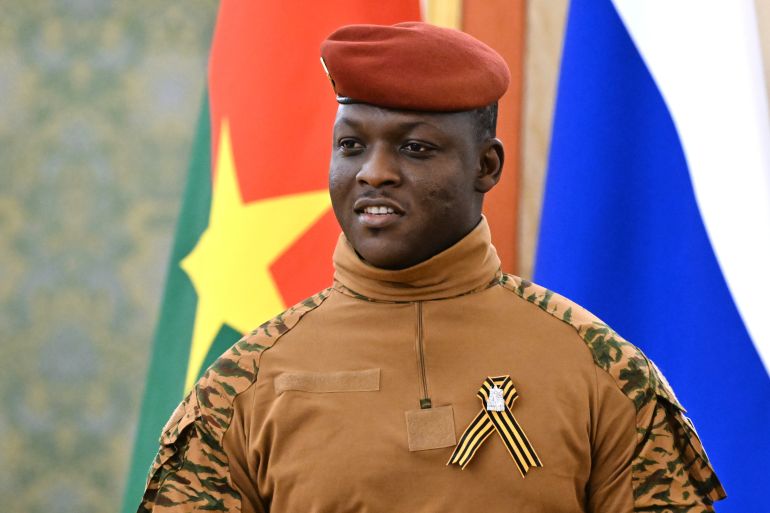
Ibrahim Traoré, the military ruler of Burkina Faso, has called on citizens to abandon the idea of democracy, marking a further shift away from earlier promises to restore civilian rule.
In a televised interview on Thursday, Traoré stated that democracy is not suitable for the country, arguing that attempts to impose it have often led to instability and violence.
Criticism of Democratic Systems
Traoré pointed to Libya as an example, suggesting that foreign-backed efforts to introduce democratic governance there resulted in conflict rather than stability.
He argued that systems labelled as democratic have, in some cases, brought hardship rather than progress, adding that Burkina Faso must follow its own path.
His remarks reinforce a growing stance by the military government against Western political models.
Shift Away From Election Promises
The comments come despite earlier commitments by Traoré to organise elections. After taking power in 2022 following a coup that removed former president Roch Marc Christian Kaboré, the military leadership initially pledged a return to democratic governance.
Elections were originally expected in 2024, but authorities later postponed them, saying voting could only take place once the country’s security situation improves.
Political Crackdown Intensifies
In recent months, the government has taken sweeping actions to tighten control. More than 100 political parties have been dissolved, with their assets seized.
Parliament had already been suspended following the coup, and the national electoral commission was disbanded in 2025, with officials citing cost concerns.
Observers have also raised alarms about increasing pressure on journalists, opposition figures, and members of the judiciary.
There have been reports of critics being forcibly recruited into military service and deployed to conflict zones, though some were later released.
Ongoing Security Challenges
Burkina Faso continues to face attacks from armed groups linked to extremist organisations, including al-Qaeda and ISIL. Large parts of the country remain affected by violence, with hundreds of thousands of civilians displaced.
Despite the military government’s pledge to restore security, attacks have persisted, and casualties have risen significantly in recent years.
Regional Shift in the Sahel
Burkina Faso is not alone in its current direction. Neighbouring countries such as Niger and Mali, also under military rule, have taken similar steps by limiting political activity.
All three nations recently withdrew from the Economic Community of West African States and formed a new alliance known as the Alliance of Sahel States.
The countries have also distanced themselves from France, previously a key military partner in the region, and have instead strengthened ties with Russian-backed security forces.
Rising Violence and Human Impact
The security crisis continues to deepen. According to recent analysis, fatalities linked to the conflict have sharply increased since Traoré came to power, with deaths far exceeding figures recorded in previous years.
The ongoing instability has had a severe humanitarian impact, leaving large populations displaced and communities struggling to cope with continued violence.